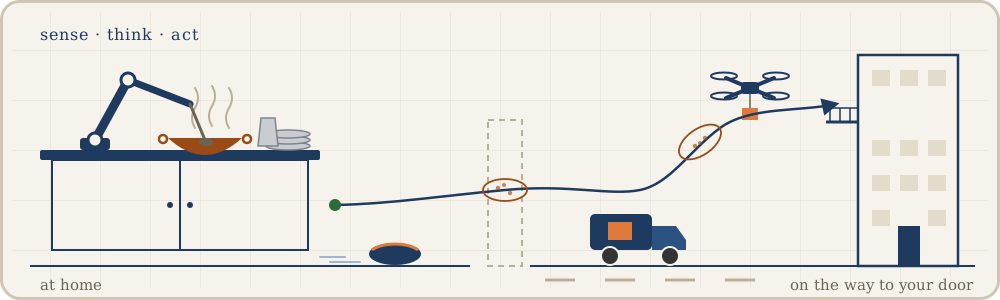
Robots That Perceive is an open, notebook-based textbook. Every section is a Jupyter notebook: read the explanation, study the equations, then run the code, change a parameter, and watch the robot behave differently. Everything runs in your browser. There is nothing to install.
The book follows one idea. A robot senses its world, reasons about what it sensed, and acts, over and over. Part I builds the tools for each step. Parts II and III put them to work on robots from everyday Indian life: in the kitchen and home, and on the way to your door.
Part I · Foundations
What a robot is, the sense–think–act loop, and models of motion and measurement.
Probability, sensor models, Bayes’ rule, and decisions under uncertainty.
Part II · Robots at Home
Recognising plates, tumblers, and kadais; fusing sensors; learning from examples.
Arm geometry, reaching the masala dabba, and smooth stirring and pouring.
Wheels on wet floors, mapping a home, and cleaning every tile.
Part III · Delivery Robots for Indian Streets
Localization, particle filters, route planning, and the lift-or-stairs decision.
Vehicle motion, tracking two-wheelers and pedestrians, and mapping a busy street.
3D rotations, hovering with a payload, and rooftop-to-balcony flight paths.
Who this book is for
The book assumes school-level calculus and algebra, some familiarity with vectors and matrices, and basic Python. No previous robotics or probability course is needed. Each section takes 30–60 minutes and ends with Try it exercises and key takeaways.